

 0
 0
Bus Escape: Traffic Jam — How It Actually Works
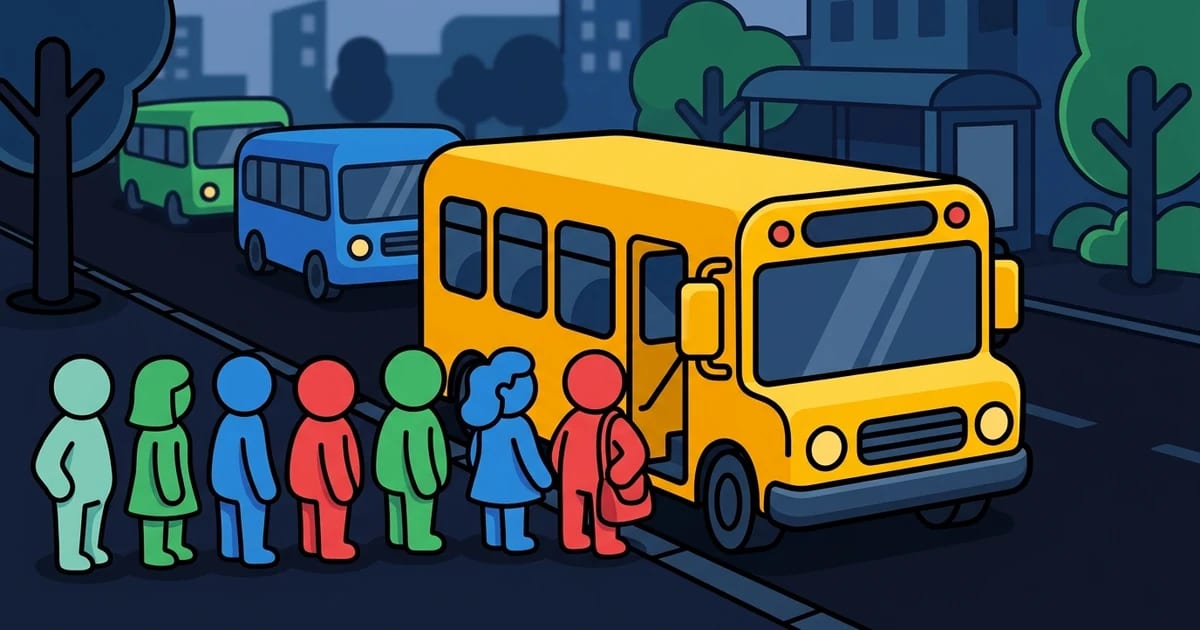
Bus Escape: Traffic Jam is the most-played game on this site, and it is also the one people most often go looking for help with. The problem is what they find.
Most guides you will find are for a different game
Search for a Bus Jam or Bus Escape guide and you will get advice like "each vehicle can only move forward or backward in the direction it faces", "clear the perimeter first to make space", and "unblock the outer cars before the inner ones".
None of that applies here. That advice belongs to the Rush Hour-style parking puzzle, where you slide cars around a gridlocked lot. Several different games share these names, and the one on this page is not that one. In this game no vehicle moves at all. You never touch a car. The bus arrives on its own, and the only thing you control is which passenger walks to it.
Everything below was checked by playing the build on this site rather than read somewhere.
How it actually works
| Piece | What it does |
|---|---|
| The bus at the stop | Has a colour and three seats |
| The grid of passengers | Colour-coded. Tap one to send them to the bus |
| The bench above the grid | Seven slots, two locked behind an ad button |
| The road to the left | The buses queued behind the current one, in order |
Fill all three seats and the bus pulls away, and the next one in the queue takes its place. Clear the grid and the level is done.
The two rules nobody states
Only the matching colour responds to a tap. This is the thing worth knowing first. On level 1 there is a salmon bus at the stop and nine passengers in three colours. Tapping a red one does nothing — no animation, no error, no sound. The game simply ignores it. A beginner reasonably concludes the game is broken or that the passenger is stuck behind something. It is neither: wrong colour, no move.
Position in the grid does not matter. The back row is as tappable as the front. A passenger at the very back boarded perfectly well while three others sat in front of them, which rules out the queue-and-blocking model these puzzles usually use. There is nothing to dig out. If a passenger will not move, it is the colour, never the position.
Put those two together and the level is not a spatial puzzle at all. It is a reading exercise.
Read the road, not the grid
Because the grid never blocks you, the only real question is what is coming next — and the game tells you. The buses waiting behind the current one are drawn on the road to the left, in order, in their colours.
That queue is the actual information in the game. Before you tap anything, look left and count: if two salmon buses are coming and only four salmon passengers are on the board, the second one leaves with an empty seat and that is a seat you will want back later. Match your tapping to the queue rather than to whatever colour your eye lands on first.
What changes after level 1
Level 1 is a tutorial in disguise: it is 3×3, and each row is a single colour, so you cannot help but learn the loop. Level 2 drops the training wheels — the grid becomes 4×3, a fourth colour joins, and the colours are scattered across it rather than grouped.
That is the whole difficulty curve in miniature. What gets harder is not the moves; it is finding all four of one colour in a scattered grid before you lose track. Scan the board colour by colour rather than cell by cell, and the later levels stop feeling crowded.
About that bench
The seven slots above the grid are the waiting area, and five of them are open — the two purple ones carry a video icon and are unlocked by watching an advert.
Worth saying plainly: playing through the opening levels, it never came into use. Passengers walk across it on their way to the bus and nothing stays there. That is useful to know in itself, because it tells you where the early difficulty is not. Do not spend an ad on extra slots before you have hit a level that actually fills them.
The short version
Nothing on the board blocks you and no vehicle moves. Only the colour currently at the stop will respond. The buses behind it are visible, and reading that queue before you tap is the entire skill. The rest is just spotting one colour in a crowd.
Play Bus Escape: Traffic Jam — it runs in the tab, free, no sign-in.